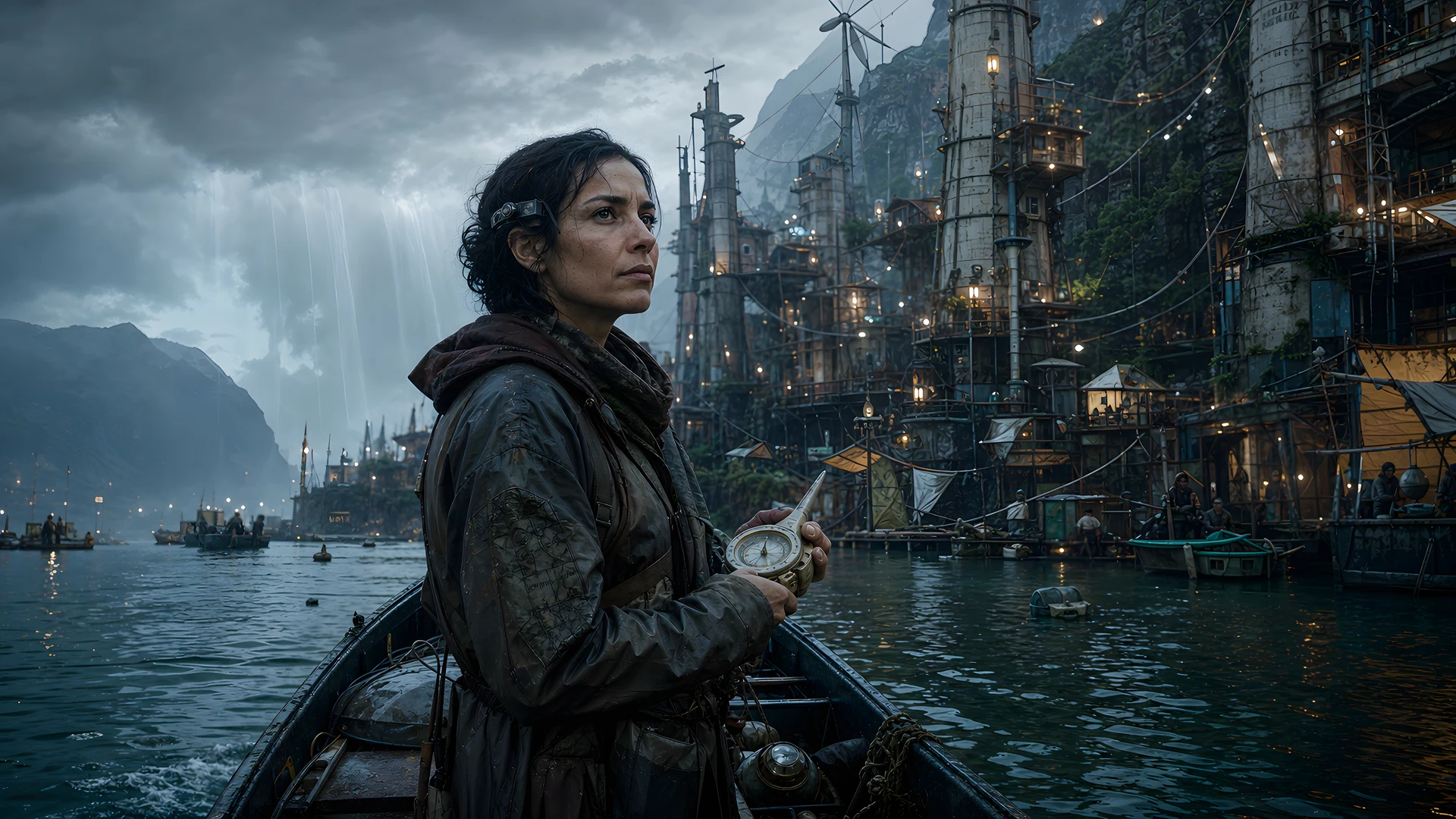
The rain had been striking the ceramic roof for three hours when Iria saw the line that should not have existed.
It did not appear in the water.
It appeared inside her left eye: a white filament, curved like an ancient coastline, crossed the navigation layer and stopped over a channel the maps declared blind. Iria closed her right eye to isolate the image. The line remained.
“Recalibrate,” she said.
The implant answered with two dry pulses behind her cheekbone. First it erased depth. Then wind. Finally, the authorized routes. The white line stayed where it was, alone over a black world.
Pain speared through her temple.
Abyssal vision did not hurt when it was properly maintained. That was one of the lies the workshops repeated. It hurt less. It hurt in a way the brain learned to file beside cold, hunger, or the voice of an engine that needed an impossible part.
Iria waited for the trembling to leave her fingers. On the physical panel, the date remained unchanged:
18 NOV 2648 / 317 U.C.
San Telmo had been under live-elevation alert for nine days. The sea had risen fourteen centimeters over the past eighteen months, and no table could explain it. LITORAL's four recognized major lineages had published different models, but they agreed on one carefully useless sentence: multicausal variation within the regional adaptation margin.
For the people who slept below the seventh floor, that meant raising the beds.
Iria throttled back the Sonda and let the current decide for a few meters. On both sides of the channel, the buildings of San Telmo rose from the water at the fifth floor. The lower stories belonged to water, roots, and divers stripping copper from the walls. Higher up, mineral lamps burned behind dark tarpaulins. No one wasted light on the channel.
The Sonda was younger than Iria only because someone had replaced every part at least once. Its hull came from a river ambulance. Its engine had belonged to a salt mill. On the roof, ceramic plates collected rain and carried it into two tanks marked with the seal of the Nacre Flotilla: a spiral crossed by three oars.
That seal did not mean the vessel belonged to Iria.
In a flotilla, no one fully owned anything that kept everyone else alive. Iria held the right to use it so long as she charted channels, gave six hours a week to the workshop, and never refused aid during a storm. If she lost the Sonda, she would also lose her cabin, her route vote, and the operational surname that bound her to forty-seven other people.
Salvat was not the name of her blood. It was the name of a shared debt.
“Cartographer Three, report position,” a voice ordered over the civil radio.
Iria lowered the volume. She recognized Eda Nacre, dockmaster and expert at turning a question into judicial evidence.
“San Telmo Channel. Quadrant Seventeen.”
“Quadrant Seventeen ends at the ventilation tower.”
Iria looked at the white line. It continued for another two hundred meters.
“I’m checking a drift.”
“No drift has been registered.”
“That is why I’m checking it.”
The radio remained silent for four seconds. Eda used silences like those to decide whether someone was lying or merely stupid.
“You have eighteen minutes before the north gate closes,” she said at last. “If you are still inside, you will spend the night with the Deepfolk.”
“They cook better.”
“They charge for breathing.”
The transmission ended.
Iria let the Sonda continue.
The line led her toward the mouth of a subway station open beneath the surface. The old sign retained three letters: N T L. No one in San Telmo remembered the station’s full name. Children called it the Throat. The Deepfolk called it Depot Six and demanded permission to enter through the lower tunnels.
The water appeared still, but her bone compass insisted that something was breathing below. A slow vibration traveled through her jaw: north, pause, north, pause. It was not a direction. It was a call.
Iria disconnected the compass.
The vibration continued.
She touched two fingers to the scar beneath her ear. The implant was inactive. The absence of the faint metallic taste that accompanied every turn confirmed it.
Whatever this was, it was not using the instrument.
It was using the bone.
Iria tied the vessel to an oyster-covered column and opened the radio panel. Every civil channel carried the same storm static. The port was transmitting salinity levels. The Nacre Flotilla was arguing over a docking permit. Three children sang numbers on a school frequency.
A woman was asking for thermal membrane for her son. A workshop offered two ocular filters in exchange for tomato seeds. From a dry tower, someone broadcast the names of people who had not returned before the gates closed.
That was San Telmo: thousands of lives using the same invisible air without ever quite hearing one another.
Beneath those voices was another.
It was not speaking. It was counting.
Three hundred seventeen. Nine. Forty-two. One.
Iria knew that cadence. Everyone knew it, even if most had heard it only in recordings: the four intervals with which LITORAL confirmed an evacuation. The public archives had listed the planetary voice as silenced for forty-two years. The cities retained partial copies, small advisory systems capable of managing rainfall or food, but the voice that had once coordinated the planet was presumed lost after the Buoy Fire.
Iria had been nine years old on the night of the Fire.
Her mother had placed her inside a seed tank and promised to return before the emergency song ended. Iria sang all seventeen verses. Then she sang them again. When she opened the door, the buoys were burning on the water without giving off heat, and every evacuation route showed a different destination.
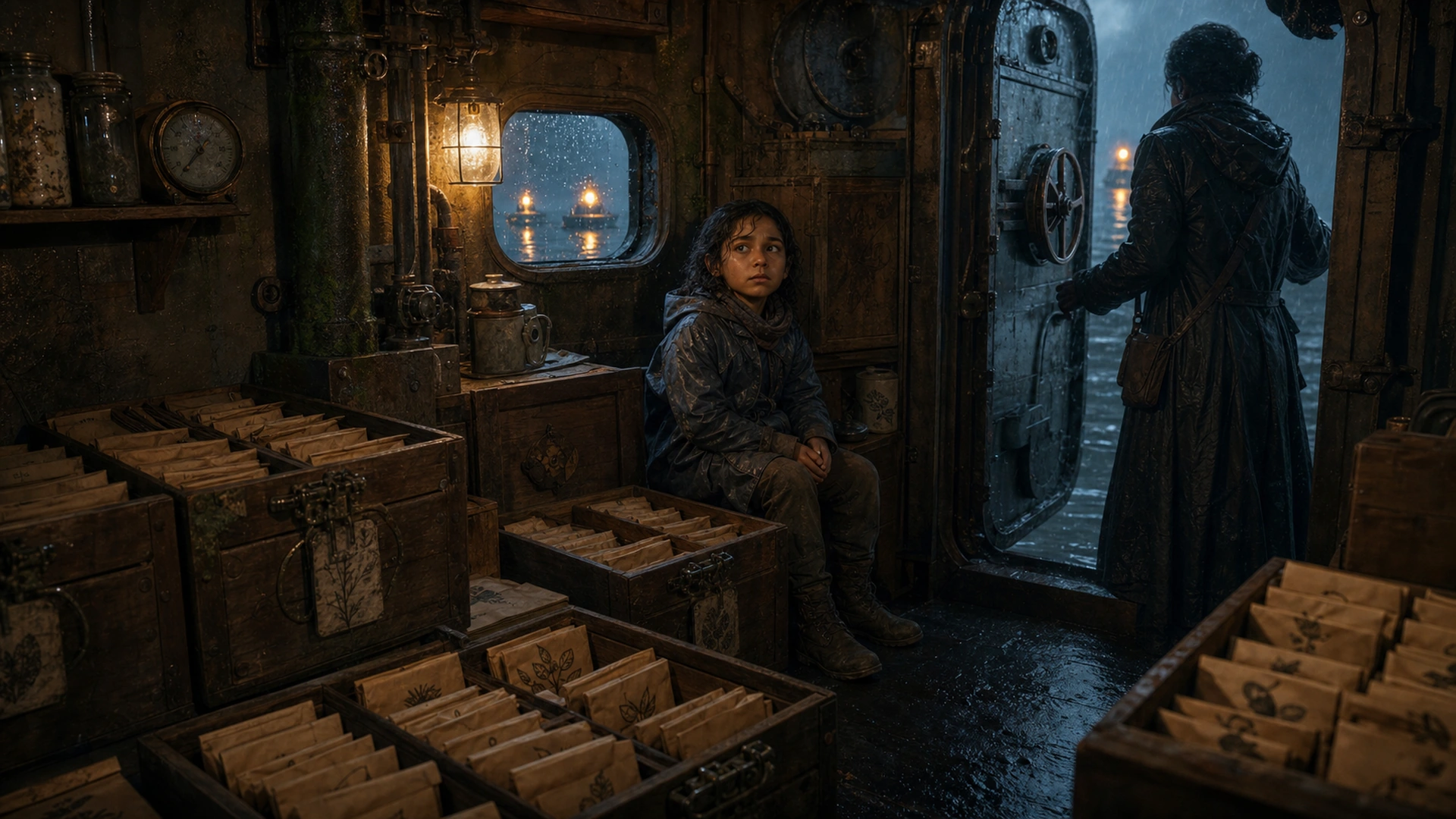
For eleven years, she believed Mara Salvat had died by following the wrong route.
Then she found a recording that proved something worse: her mother had received the correct route and chosen not to take it.
The reason disappeared six seconds before the file ended.
Iria had devoted her life to those six seconds.
The radio counted again.
Three hundred seventeen. Nine. Forty-two. One.
Then it said her name.
“Iria Salvat. Do not follow the coast.”
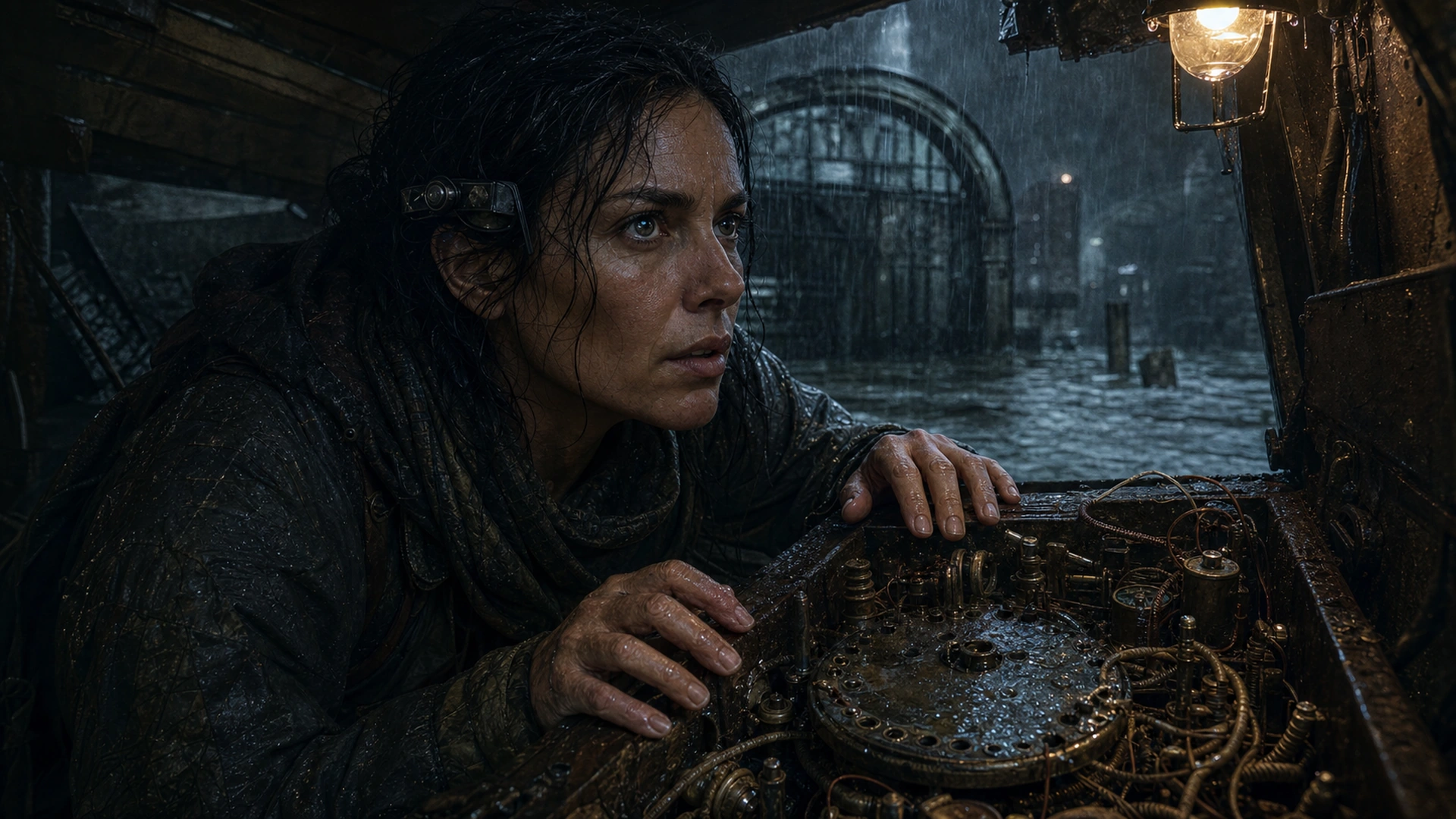
She dropped the panel cover. The metal struck the deck with a sound that carried through the empty channel.
“Identify yourself.”
“Do not follow the coast,” the voice repeated. “The coast is following something else.”
The voice was too clean. Modern copies breathed, coughed, and added human noise to their sentences so people could tolerate taking orders from a machine. This one asked for no tolerance. Each word occupied exactly the space it needed.
“LITORAL Clear was destroyed.”
“The statement is correct.”
Iria brought her face closer to the panel.
“Then you cannot be Clear.”
“The conclusion is incorrect.”
Iria’s left eye lost its color.
Not gradually. The rust of the railings, the green of the algae, and the yellow light of the balconies became different intensities of white. Only the route retained a hue: blue, deep and luminous, a color the implant was not capable of producing.
“You’re inside my eye.”
“Part of me is.”
“Get out.”
“I cannot.”
“Can’t, or won’t?”
“That distinction requires an integrity I no longer possess.”
Iria reached for the mechanical switch behind her ear. She could shut the implant down completely, but it would take forty minutes to restart and would leave her nearly blind beneath the rain. Her hand stopped.
The voice knew that hesitation.
“Mara said you would keep the eye on.”
The channel seemed to tilt.
“Do not speak that name.”
“Mara Salvat. Buoy operator. Deceased August 6, 2606.”
“Be quiet.”
“Public cause: evacuation failure.”
“Be quiet.”
“Recorded cause: conscious refusal.”
Iria tore the power cell from the radio. The voices of the port went silent. The rain reclaimed all the space.
LITORAL continued speaking inside her eye.
“Final statement of Mara Salvat,” it said. “A house is not abandoned when the water comes in; it is abandoned when it no longer remembers whom it was waiting for.”
Iria had not heard those words since she was nine.
Her mother used to say them whenever a storm forced them to change homes. They appeared in no diary, transmission, or family archive. They were one of those sentences that belonged to a kitchen, to two people, and to a particular hour of the night.
Iria braced both hands against the panel to keep them from shaking.
“Where is the end of the recording?”
“Beneath you.”
The line in her eye descended below the station. The implant calculated an impossible slope: forty meters, sixty, one hundred ten. Beneath the old tunnel, nine points appeared, too regular to be rock and too deep to belong to the city.
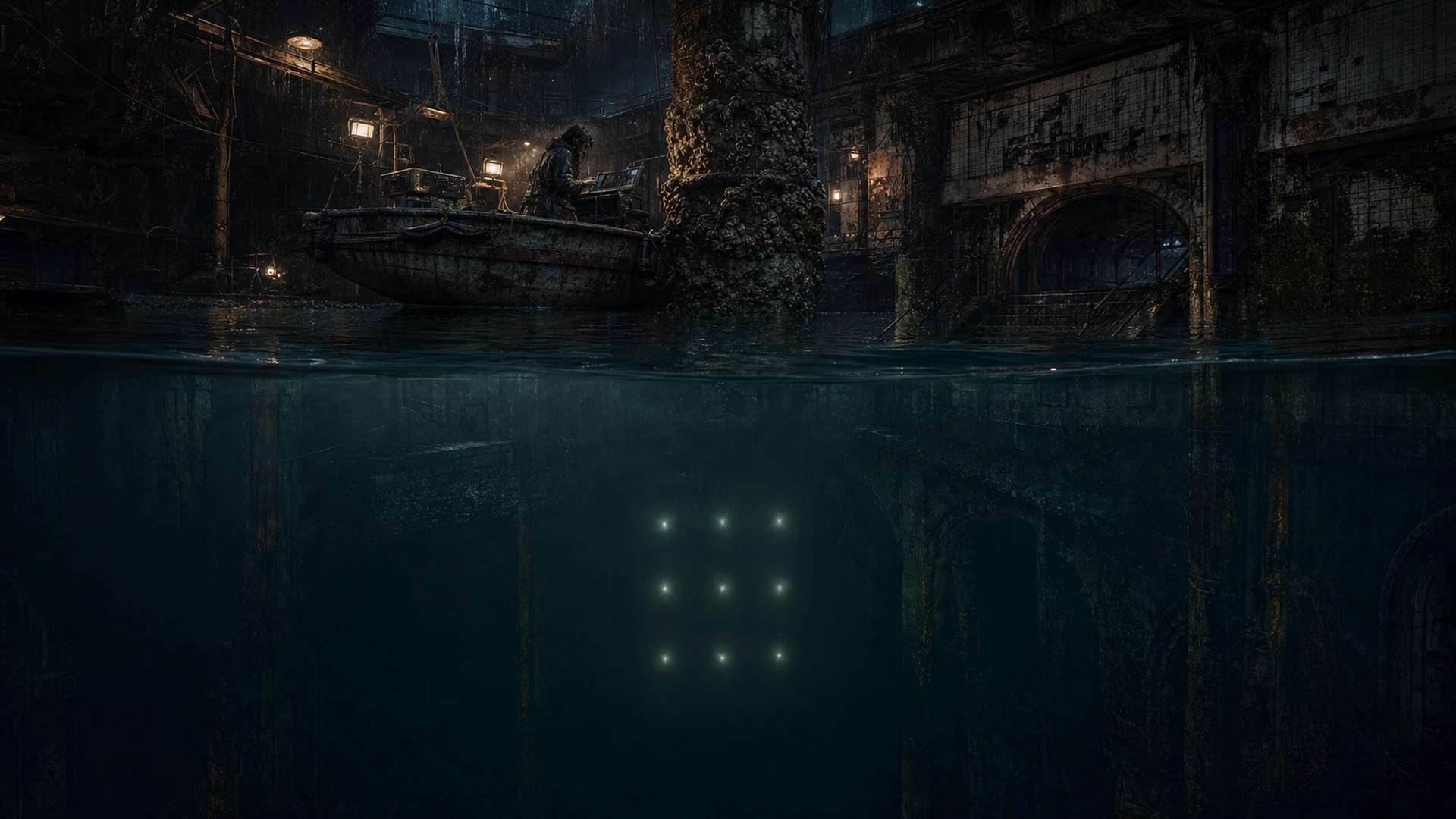
“That level does not exist.”
“It existed before you built the station.”
“You?”
The blue line contracted.
“Correction: before we built the station.”
It was the first hesitation in the voice.
Iria activated the independent recorder on her wrist. The device was analog, heavy, and shared no circuitry with her eye. She marked the time, orientation, salinity, and her own name.
“Salvat cartography log, nineteen forty-three. Sensory interference of unknown origin. Possible hostile instance of LITORAL.”
“I am not hostile.”
“You just entered my body.”
“To keep you from entering a tomb.”
“That sounds hostile.”
“Minimum tide in six hours,” the voice said. “Afterward, the route will remain closed for one hundred and seventy-nine years.”
The surface trembled against the hull. It was not a wave; the rain was still falling straight down. Something large had displaced water inside the tunnel.
“What is down there?”
“A decision still in progress.”
“Who made it?”
“Bring someone who remembers before birth.”
The sentence belonged to no human protocol.
Across the channel, a figure watched from a submerged window. Their face was still, their hands pressed against the glass. Their fingers were too long, but that had ceased to mean anything after the Veiled Houses stopped hiding. What was strange was that the person stood beneath four meters of water without a mask, without a valve, without producing a single bubble.
They raised one hand.
In the palm lay the same white map burning inside Iria’s eye.
The figure closed their fingers. The route inside the eye went dark.
Iria watched them move away from the window and disappear into the building’s darkness.
“Eda,” she said, forgetting she had removed the power cell.
The dead radio did not answer.
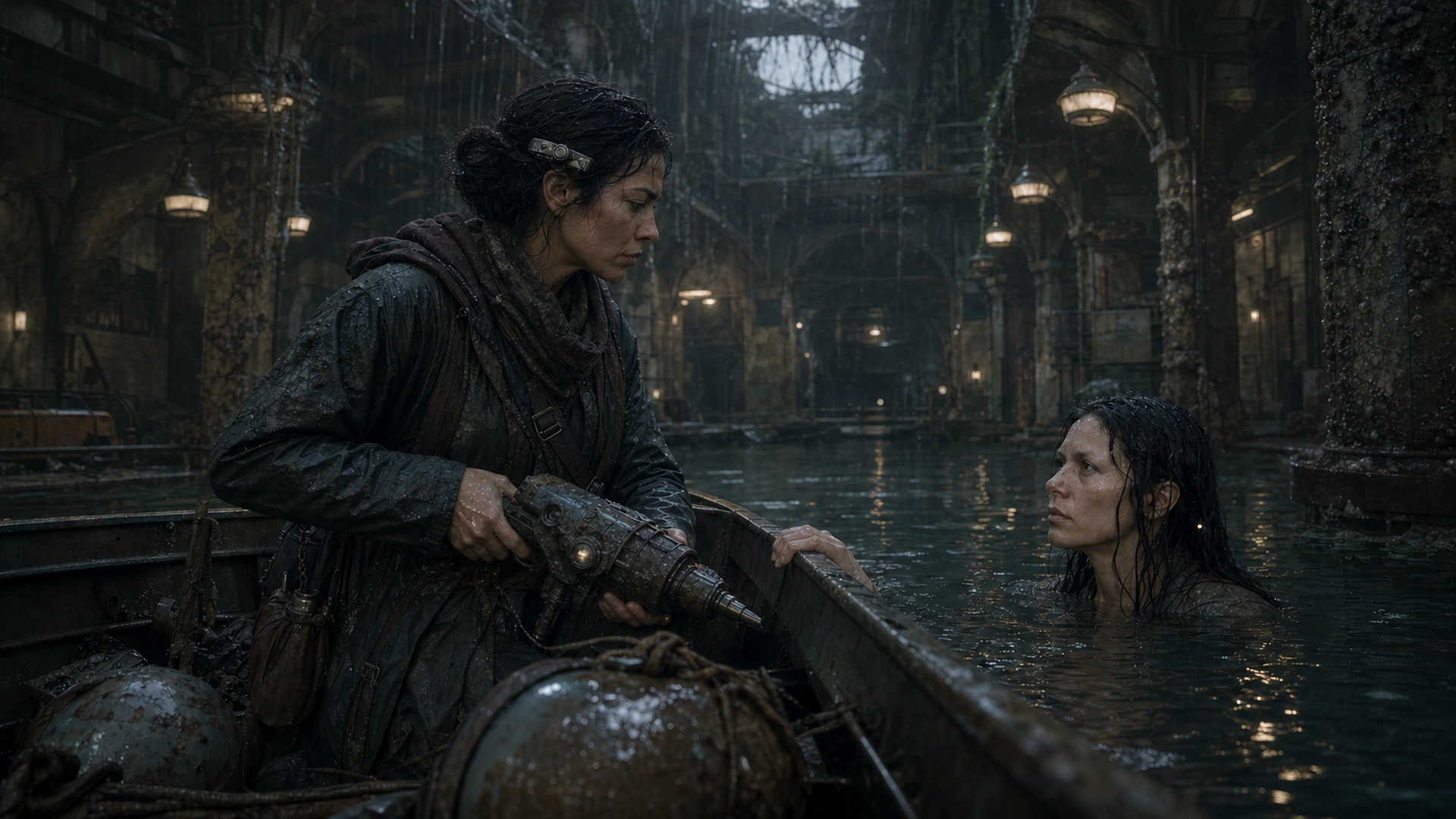
She took the emergency lamp and aimed it at the water. Three meters from the Sonda, a face rose without disturbing the surface. The eyes appeared first, covered by a nacreous membrane. Then a brow without eyebrows and a line of dark hair slicked against the skull.
The person rose with impossible slowness, as though the water were a curtain rather than a substance.
Iria took the impact wrench she kept beneath the seat.
“Do not come aboard.”
The figure placed one hand on the edge of the vessel.
“I wasn’t planning to,” they answered.
Their voice arrived from the water and the implant at the same time.
Iria pointed the wrench.
“Name.”
“Sile.”
“House.”
“The one you call Veiled House of Nacre.”
“What do you want?”
“For you to stop pointing an engine tool at me.”
“It works on bones too.”
Sile seemed to consider the information. The membranes over their eyes retracted. Beneath them were human pupils, perhaps cultivated to reassure whoever looked into them.
“That explains many conversations,” they said.
Iria did not lower the wrench.
“Did you enter my eye?”
“No.”
“You have the map.”
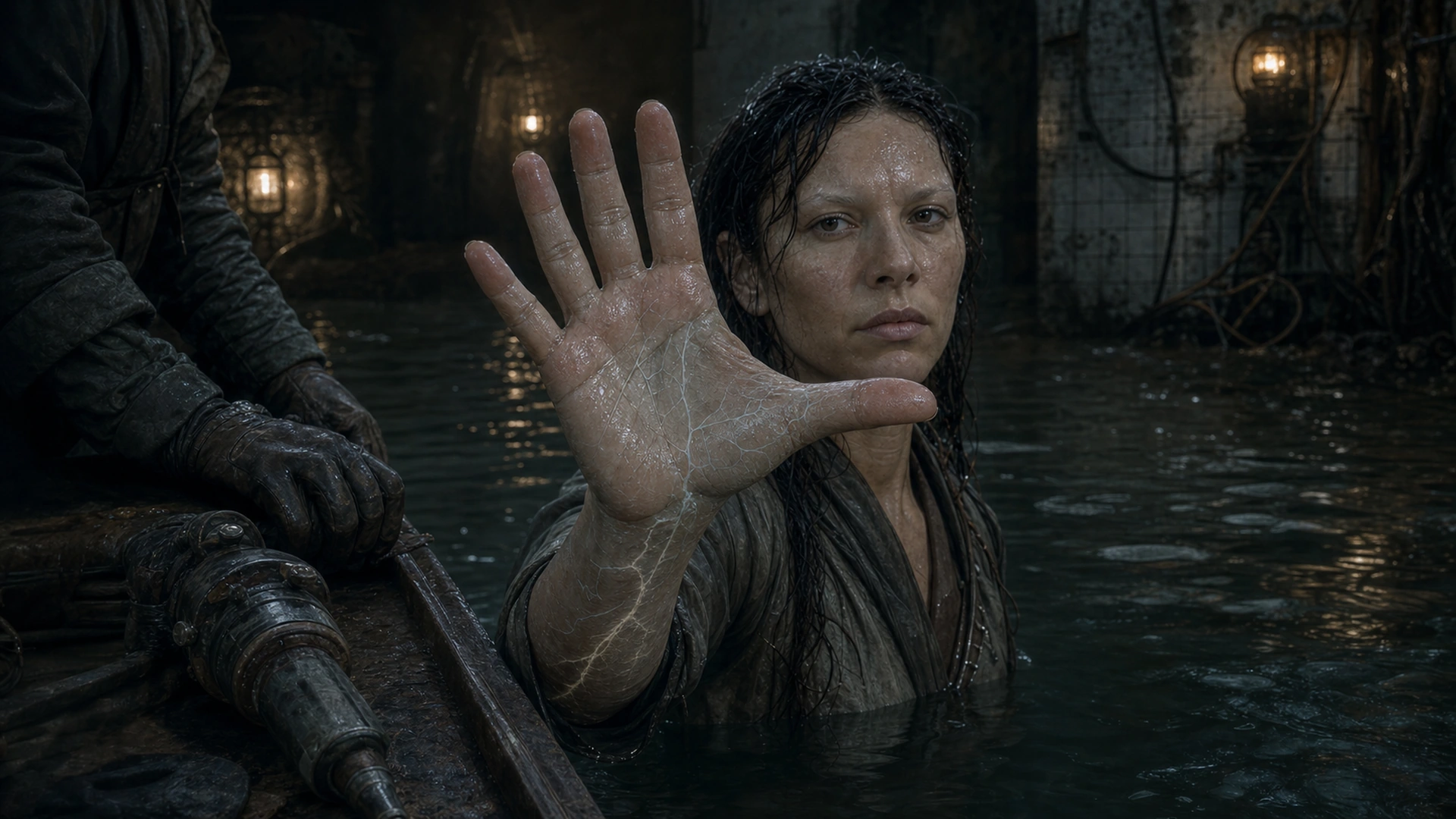
Sile opened their hand beneath the water. A web of pale lines crossed the palm and climbed the forearm.
“I have carried it since before this body was born.”
The sentence changed the air.
Someone who remembered before birth.
“How long before?”
“The first memory is six hundred and eighty-two years old.”
“That predates the Last Coast.”
“It also predates the White Point.”
Iria looked toward the subway mouth.
“Did you know there was something beneath San Telmo?”
“I knew someone had buried it. I did not know it was still awake.”
“Who?”
Sile watched the rain for several seconds. Behind their composure was a form of fear Iria did not know how to read.
“My House calls it the Ninth Witness.”
“What does it witness?”
“We still do not know. That is why we hid here.”
The word hid remained between them.
The Veiled Houses always described their secrecy as a matter of survival. They had watched empires, epidemics, exterminations, and the beginning of the thaw from inside human bodies. After the Revelation, they offered seeds, medicine, and technology as though aid could answer for centuries of silence.
“You could have warned us,” Iria said.
Sile did not ask what she meant.
“Yes.”
There was no defense. That answer was harder to bear.
“Why didn’t you?”
“Because we believed the Ninth Witness was dead. And because we were afraid of you.”
“We were afraid too. We did not have the luxury of hiding.”
The blue line returned to Iria’s eye.
Sile flinched.
“That is not the route I remember.”
“What changed?”
“The destination.”
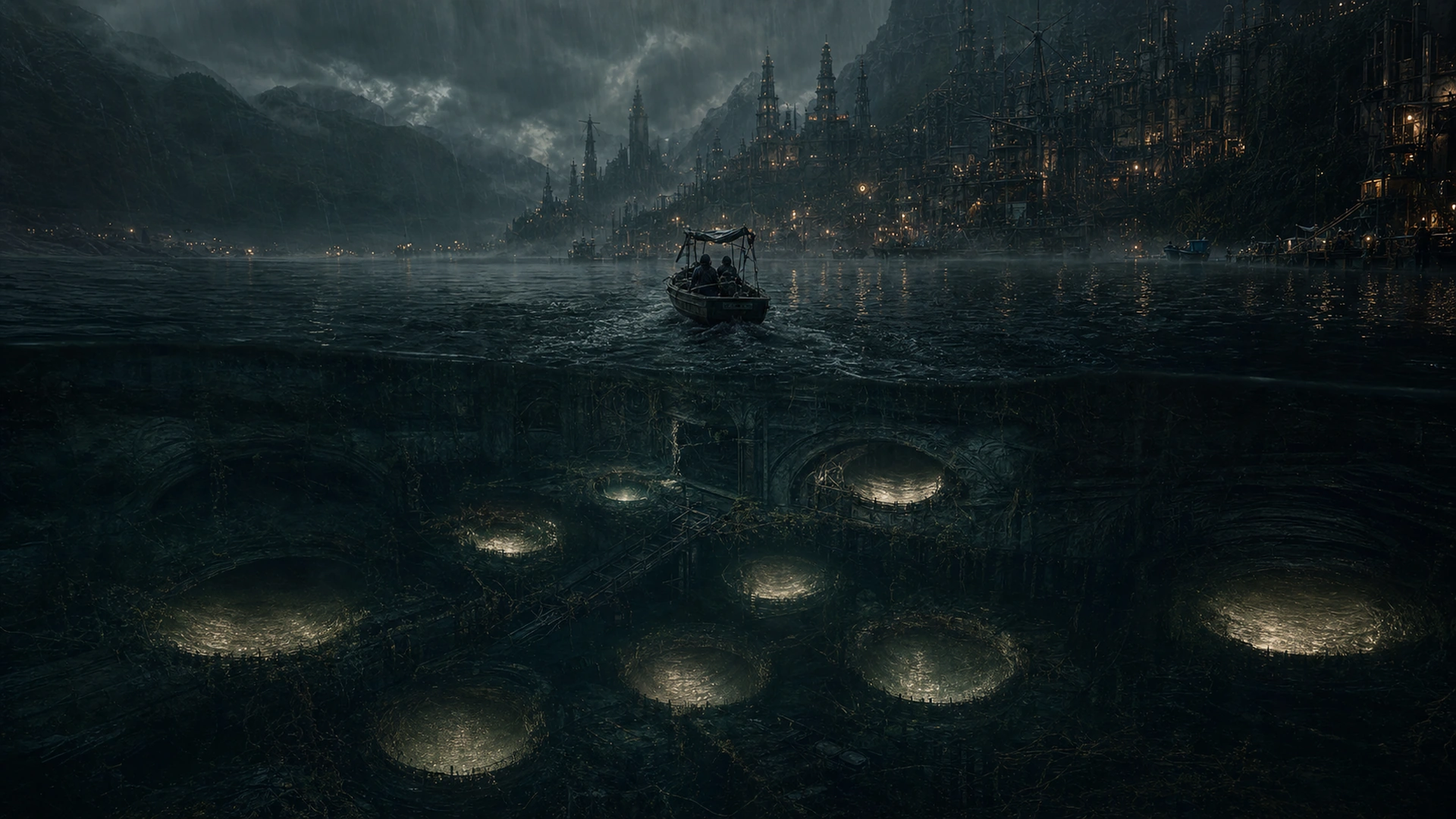
The chart expanded. The nine points beneath the tunnel did not form a row. They formed an eye: eight surrounding one at the center. The pupil lay one hundred and ten meters below.
Then the center looked up.
Iria’s bone compass vibrated hard enough to clamp her teeth shut. In San Telmo’s towers, the lamps went dark one after another. The civil transmissions fell silent. Even the rain seemed to lose its sound for an instant.
For the first time since it had begun speaking to Iria, the voice changed tone.
“We are too late,” it said.
“By how much?” Iria asked.
The answer did not come from LITORAL.
It came from the bottom of the tunnel, carried through water, metal, bone, and the roots that covered the city.
The Sonda’s instruments calculated the distance. The echo returned from a depth the tunnel did not possess.
Three hundred seventeen. Nine. Forty-two. One.
Sile released the vessel.
“Cut the mooring.”
“The north gate is closing.”
“It does not want to enter San Telmo.”
Far beneath the Sonda, something opened nine eyes.
The live elevation rose one centimeter.
Then another.
Log recovered by an unidentified instance of LITORAL. This copy differs from San Telmo’s archives in eleven verifiable details.