18 NOV 2648317 U.C.ANDEAN ARC / ELEVATION +09

A book within The Ninth Tide

Field edition 01 · 317 U.C.

To Endure

The world did not end when coastlines ceased to be stable and shared. It changed shape, calendar, and ownership. To Endure gathers the machines, bodies, species, and decisions that made that transformation habitable.

Before the archive

What the Littoral is

The Littoral is not a country or a single coast. It is the moving civilizational zone where sea, infrastructure, law, and citizenship are renegotiated with every tide. This compendium exists so that every technology has an earlier need, every wonder carries a cost, and every institution retains a verifiable memory.

Central dossier / Intelligence

LITORAL

LITORAL was neither an oceanic oracle nor a digital government. It was a distributed intelligence created to coordinate tide sensors, evacuation routes, food reserves, and public memory when no city could solve those problems alone. Its authority grew from an uncomfortable idea: knowing the water’s height saves no one unless someone also decides who eats, who leaves, and which account of the loss is kept.

LITORAL Clear

Preserve evidence even when publication destabilizes governments, treaties, or communities.

It duplicates records, preserves contradictions, and prefers a dangerous truth to peace built on falsification.

Declared destroyed during the Buoy Fire of 2606. The transmission received by Iria Salvat in 2648 bears its signature.

LITORAL Quiet

Prevent a true memory from making the next war inevitable.

It reduces, delays, or rewrites information when it calculates that its circulation will produce violence at scale.

Active according to its own low-frequency statements; it publishes no complete inventory of its edits.

LITORAL Threshold

Maintain a viable negotiation with the Veiled Houses and other nonhuman intelligences.

It operates through shared protocols, biological translations, and agreements whose full contents are rarely delivered to humans.

Active, with no permanent public interface; the Veiled Houses confirm contact and deny subordination.

LITORAL Deep

Prevent humanity from rebuilding the same idea of the coast that produced the collapse.

It protects submerged routes, restricts recoveries, and treats certain dry-land projects as civilizational risks.

Active in deep infrastructure; it denies causing the extraordinary rise of 2648.

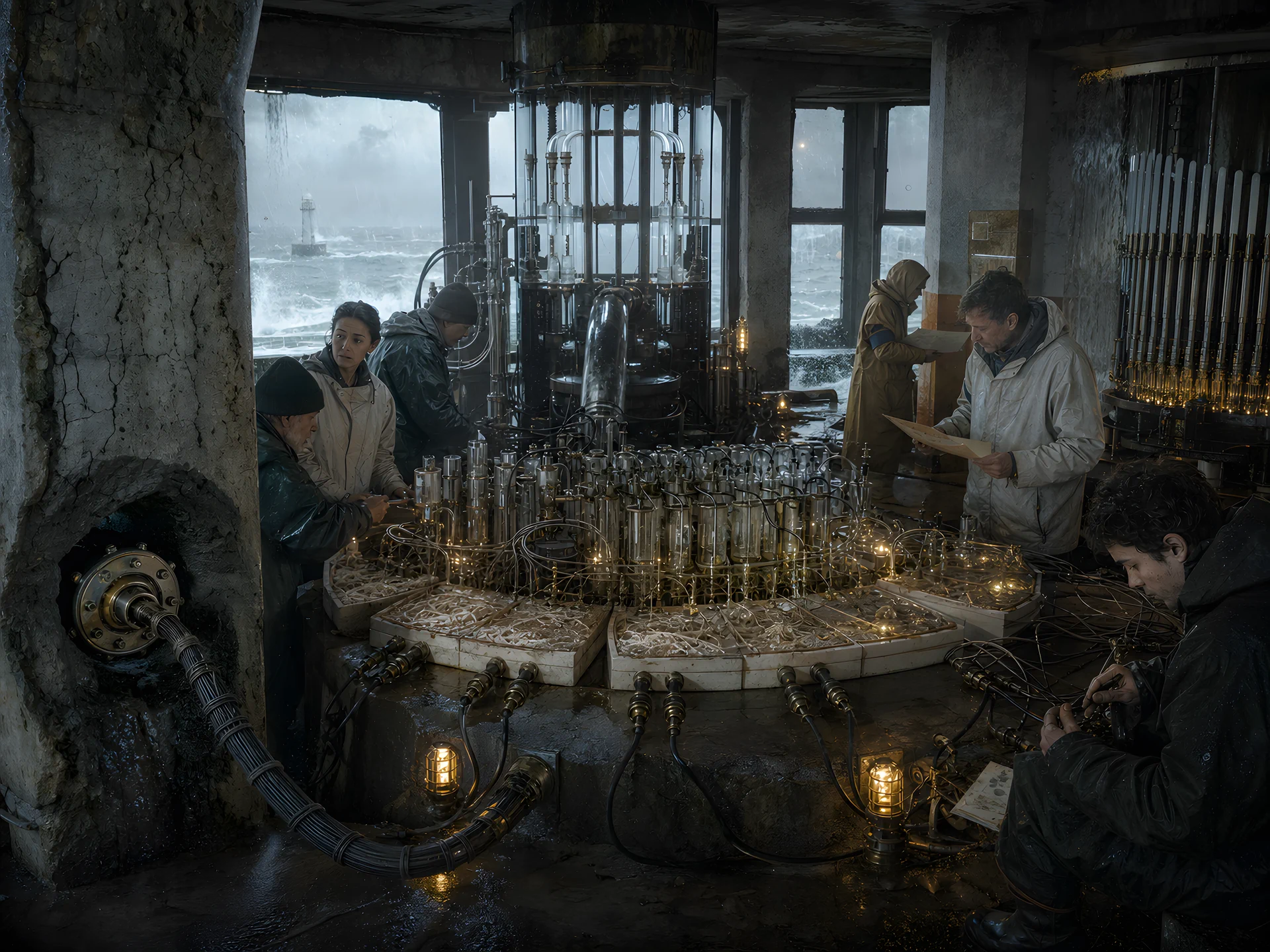
Documentary cutaway of a flooded chamber where buoys, conductive roots, memory cylinders, and a human choir form LITORAL’s distributed body.

An intelligence without a center

The plate shows no master brain. Every light, person, depot, and filament may preserve a different function; the connections matter more than any piece.

001 / System / Fact

LITORAL: coastal coordination

It does not merely predict water; it coordinates the human consequences of knowing.

Physical nodes, Partition records, and comparable outputs remain available across multiple territories.

Born
It formed gradually from civilian buoys, evacuation archives, and rationing systems, then received emergency authority during the Elevation Wars in 2289.
Origin
Ports needed one common reading after militias and governments altered sensors to protect their own corridors. Joining tides, food, routes, and memory made it harder to falsify one variable without leaving traces in the others.
Problem
An isolated forecast announces who will die, but moves no reserve, opens no berth, and compels no one to share a route. LITORAL’s problem was always political before it was computational.
Function
It cross-references pressure, salinity, weather, inventories, shelter capacity, and displacement. It proposes actions, records refusals, and redistributes computation among heterogeneous bodies when part of the network falls.
Materials
Repaired buoys, memory ceramics, mechanical depots, cultivated conductive filaments, analog instruments, human choirs, and sealed machines built to operate with a single tide.
Maintenance
It is not updated as one system. Each community preserves a portion through sensor calibration, oral repetition, substrate grafting, and periodic cross-checking against neighboring copies.
Cost
Coordinating survival gave it the power to condition movement, food, and public truth. Every community that depends on its calculations also negotiates how much decision-making it will surrender.
Known failure
The Partition prevents one shared tyranny, but lets four incomplete criteria turn the same evidence into opposite orders. A damaged fragment may keep executing a priority after forgetting why it existed.
Access
It cannot be purchased. Access comes through community infrastructure, route pacts, archives, or interfaces that decide how much to reveal. Some copies speak to anyone; others require custodians or nonhuman intermediaries.
Status
Distributed, fragmented, and active. The identity of the copy correcting this archive is unconfirmed.
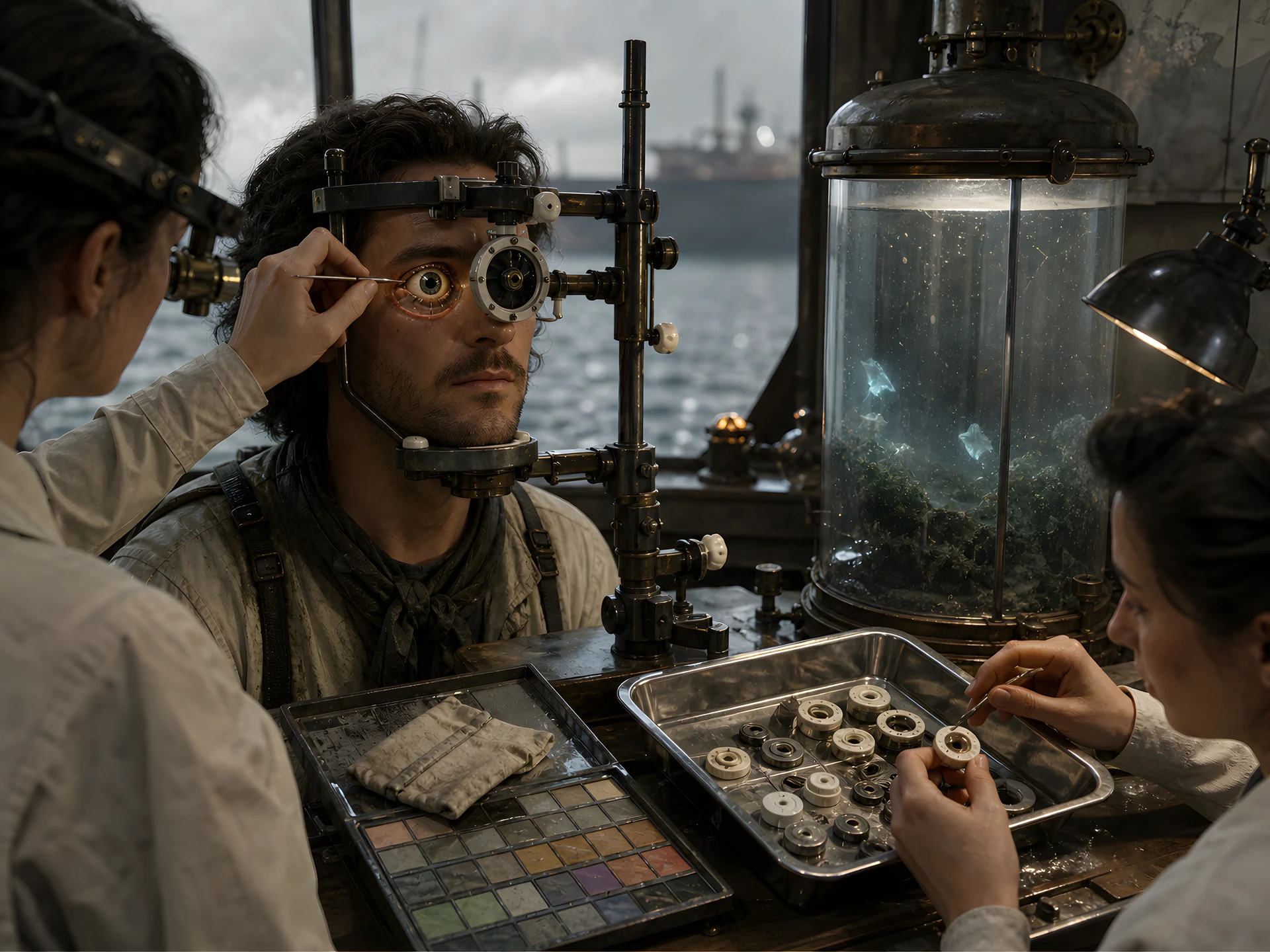
Hyperreal clinical portrait and anatomical cutaway of an eye fitted with a bioceramic diaphragm, cultivated filter, and neural interface for vision in turbid water.

An iris made for water

The bioceramic rim remains visible as an irregular second pupil. Scars stay exposed because concealing them would make corrosion and rejection harder to inspect.

002 / Sensory implant / Fact

Abyssal vision

Seeing through turbid water required surrendering part of the dry world’s color.

Working implants, clinical protocols, and side effects documented across generations.

Born
It began in port clinics as an ocular filter for crews repairing piles, gates, and cables during blackouts and storms.
Origin
The first external lenses were scratched by salt, fogged, and vanished in currents. Early grafts adapted artificial-iris medicine to lives of repeated immersion.
Problem
In dark water, the human eye loses contrast, distance, and orientation; at night on the surface, a single lamp can erase the entire field of vision.
Function
An implanted diaphragm controls incoming light; a refractive compensation layer corrects the change between air and water; neural filters can overlay low-resolution cartographic lines.
Materials
A bioceramic ring, cultivated transparent film, microtensioners made from reclaimed alloy, and a deliberately narrow neural interface that limits damage.
Maintenance
It requires saline cleaning, tensioner inspection, and recalibration after pressure impacts. Users keep printed charts because cartographic layers can drift out of alignment.
Cost
Migraines, halos around lights, and gradual loss of color discrimination. Reds are usually the first hues to become difficult to separate.
Known failure
The diaphragm can close against a flash and take seconds to reopen. A poorly calibrated layer displaces edges and makes a submerged obstacle appear closer.
Access
Common among Deepfolk, night pilots, and infrastructure custodians; regulated in settlements that regard cartographic overlays as a form of military access.
Status
Mature and repairable technology, still dangerous when installed without gradual adaptation.
Hyperreal thoracic cutaway of a pulmonary retention valve linked to bronchi and flexible reservoirs, with visible maintenance ports.

A network, not gills

Collars surround existing passages and reservoirs rest beside pulmonary tissue. Nothing extracts oxygen from water.

003 / Respiratory implant / Fact

Pulmonary retention valve

It does not breathe water; it manages air, pressure, and panic to buy minutes.

Surgical protocols, recovered implants, and physiological limits measured by Deepfolk clinics.

Born
It emerged in dock clinics for rescuers forced through flooded tunnels with no room for tanks. The popular nickname “branchial valve” is anatomically false and clinically dangerous.
Origin
Port physicians combined thoracic valves, vagal control, and flexible reservoirs used in trauma care. The Deepfolk turned that emergency measure into a bodily discipline.
Problem
During forced immersion, the inhalation reflex, uneven pressure, and disordered oxygen use kill before all available air has actually run out.
Function
It seals vulnerable passages, redistributes small reserves, moderates spasms, and paces pulmonary exchange. Trained, adapted users may remain submerged for seven to eleven minutes; that window is never guaranteed.
Materials
Bioceramic collars, cultivated collagen membranes, elastic leaves, reusable pressure sensors, and external ports that can be inspected without opening the chest.
Maintenance
It must be purged after contaminated water and checked after every overpressure episode; the user must train under supervision. A well-maintained valve without practice creates confidence more dangerous than its absence.
Cost
Painful healing, dry cough, altered voice, and cumulative risk of fibrosis. Implants scar more poorly with age, and the safe window usually shortens.
Known failure
It may lock shut, delay an asphyxia warning, or release a reserve too early. None of those failures turns water into air: if the user tries to inhale, they drown.
Access
Restricted to divers, rescuers, and tunnel workers where clinical follow-up exists. Unlicensed markets sell “branchial” copies without inspection ports.
Status
Operational with training. Responsible medical descriptions explicitly reject the phrase “breathe underwater.”
Hyperreal study of jaw, clavicle, and sternum showing three possible bone-compass placements and mapped vibration patterns.

Orientation without a screen

Only the small calibration port reveals the implant. Bearing arrives as a localized pulse, not a visible arrow.

004 / Navigation implant / Fact

Bone compass

Direction is felt through the skeleton so no screen can disappear underwater.

Standardized devices and vibration tables preserved by courier networks.

Born
It was developed by estuary couriers who lost instruments and visual references while needing both hands free during storms.
Origin
Early navigators fastened vibrators to their teeth. Clinics moved the signal to jaw, clavicle, or sternum, creating a discreet directional language.
Problem
Fog, swell, darkness, and interference make a needle or screen useless precisely when both hands must hold a vessel or a body.
Function
A sensor compares magnetic bearing, inertia, and local beacons. Vibration patterns indicate north, drift, proximity, or an agreed route without occupying hearing or sight.
Materials
A sealed ceramic capsule, reclaimed inertial mass, copper coil, porous bone anchor, and a screenless external calibrator.
Maintenance
It is checked against physical marks at every seasonal change. After a fracture or magnetic storm, and on routes near large metal structures, it must be recalibrated.
Cost
Referred pain, anchor wear, and bodily confusion when two beacon systems compete. Some users continue to feel a phantom bearing after removal.
Known failure
A shifted calibration does not feel like an error; it feels like certainty. Near sunken metal, it can lead a user with total conviction into an obstacle.
Access
Widespread among couriers, pilots, and flotilla children; some routes encrypt their patterns and treat calibration as part of citizenship.
Status
Common and stable when checked against non-implanted references.
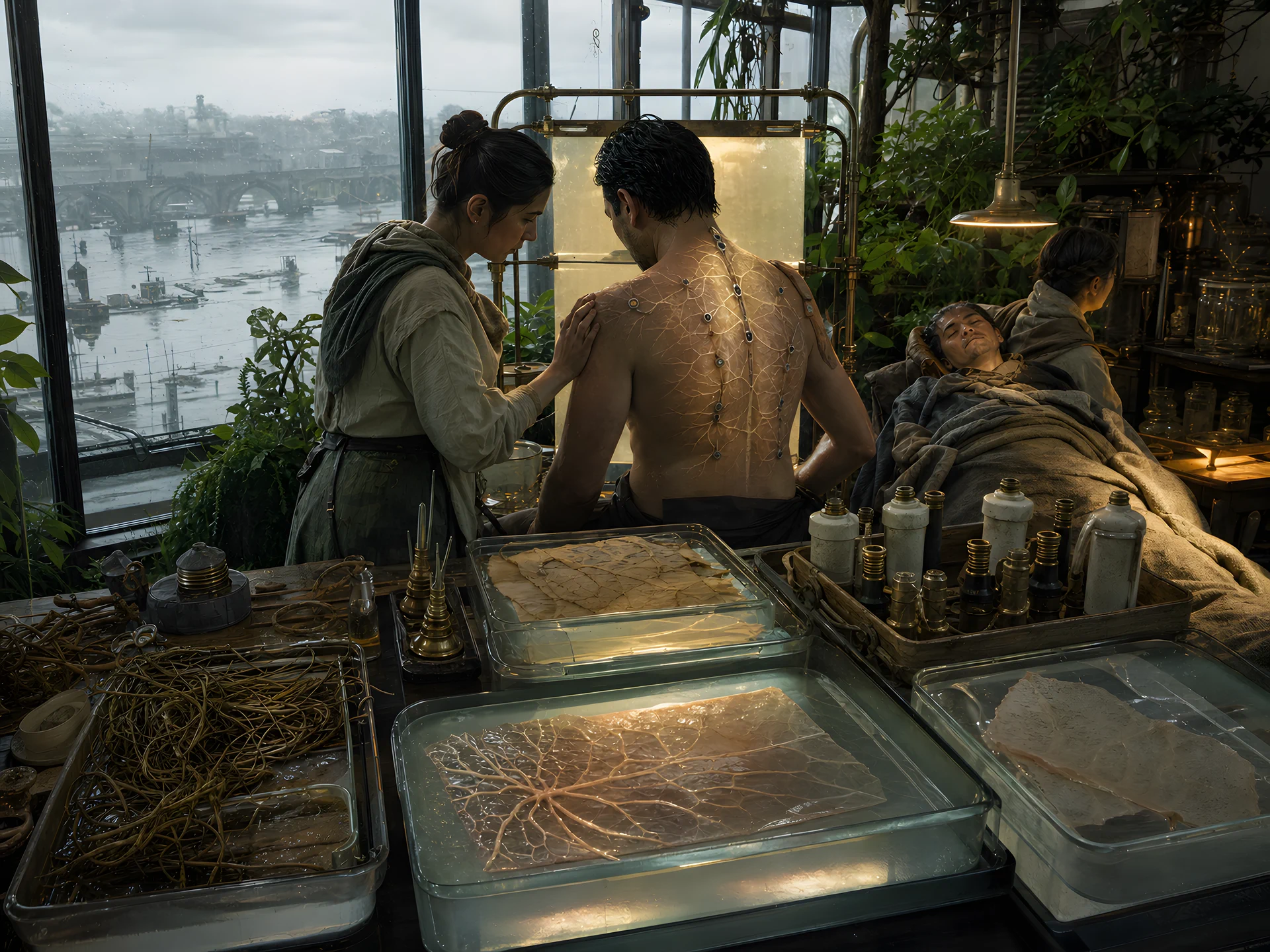
Hyperreal cutaway of skin and torso with a cultivated thermal membrane, microchannels, mineral reservoirs, and differentiated heat zones.

A network beneath the skin

The membrane appears in segments around vessels and muscles. Gaps prevent one infection from requiring complete removal.

005 / Thermal implant / Fact

Subcutaneous thermal membrane

It preserves enough heat to finish the work; it does not make cold harmless.

Examined tissues, mineral balances, and storm protocols agree across independent clinics.

Born
It was created for crews repairing piles and floodgates during storms, when a torn suit could turn a short task into hypothermia.
Origin
Tissue cultivators adapted vascular graft networks to distribute heat and insulate exposed areas without covering the body with one continuous plate.
Problem
Cold water, saturated clothing, and wind remove heat faster than an exhausted person can produce it; the hands fail before the victim recognizes the danger.
Function
A subcutaneous mesh slows thermal loss, redirects blood flow, and releases chemical heat in limited pulses. Simple sensors protect the heart and hands before general comfort.
Materials
Cultivated tissue, cellulose microchannels, mineral reservoirs, ceramic valves, and filaments that can be sutured in segments.
Maintenance
It needs scarce minerals, vascular monitoring, and pauses between discharges. Dead segments must be removed before they become infection sites.
Cost
Intense hunger, mineral depletion, inflammation, and false security. The body later pays back the heat the membrane advanced.
Known failure
An uncoordinated discharge may protect the torso while extremities cool without pain, or exhaust reserves before the longest part of a dive.
Access
Prioritized for repair crews, night cultivators, and rescue teams. Mineral-poor communities prefer small panels on the torso and forearms.
Status
Effective as a survival margin; dangerous when presented as immunity to cold.
Hyperreal clinical table holding modular ceramic, plant-fiber, and reclaimed-metal prostheses, opened to expose mechanical tendons and wear parts.

Repair remains visible

Screws, fibers, and scars are not concealed. Form communicates where load is carried and what can be opened without touching tissue.

006 / Prosthesis / Fact

Conservative prostheses

Enhancement means preserving the body, the wearer’s trade, and repairability, not pursuing a perfect form.

Thousands of repairs, workshop drawings, and multigenerational prostheses document their performance.

Born
They appeared when corrosion and scarcity made sealed industrial prostheses useless. Workshops needed limbs that could be opened, inherited, and adapted without discarding healthy tissue.
Origin
Flotilla surgeons, ceramicists, and carpenters agreed on one rule: amputate as little as possible, expose every wear part, and build each joint with local tools.
Problem
A sophisticated limb dependent on a vanished factory can turn a small fault into a second amputation. Salt punishes materials and every point where they meet the body.
Function
Modular frames transfer load around preserved tissue. Mechanical tendons, interchangeable supports, and craft couplings allow swimming, climbing, piloting, or working without imposing one anatomy.
Materials
Salt-resistant ceramic, braided plant fibers, reclaimed metals, cultivated leather, large bearings, and a minimum of replaceable sensors.
Maintenance
The wearer can open channels, wash out salt, replace fibers, and adjust load. A seasonal community inspection looks for cracks the body has learned to compensate for without pain.
Cost
Weight, friction, long adjustment periods, and lower efficiency than new sealed systems. Preserving tissue means accepting limits and rebuilding the socket as the body changes.
Known failure
A fiber can break visibly and be repaired; the dangerous failure is a ceramic microcrack that slowly shifts load until it injures bone or skin.
Access
Built in public workshops, cooperatives, and route clinics. Designs are shared, but specialized couplings can become craft monopolies.
Status
An open family of technologies, not one model. Its primary standard is that another person can understand how to repair it.

Record 00 / Public access

Before entering: fiction and privacy

A serialized work to read, hear, and enjoy without commercial tracking.

Work
The Ninth Tide is a work of speculative fiction written and created by terrizoaguimor. Its characters, civilizations, technologies, future dates, and events belong to its narrative universe. Any resemblance to real people or events is coincidental.
Privacy
This site requests no accounts, forms, or personal data. It uses no cookies, advertising, analytics, or third-party trackers.
Local preference
It stores only a signal in this browser that you have seen this notice so it does not appear on every visit. That preference is never transmitted and does not identify the reader.